Friday, May 8, 2015

Varied Adventures along Coastal Florida

Amelia Island is one of the southernmost of the Sea Islands, a chain of barrier islands stretching along the coast from S Carolina to Florida. Amelia Island is just off the coast of northeast Florida. Its beauty and tranquility of pristine and secluded beaches spreads for 13 miles.

Fort Clinch was built there during the Civil War and is one of the best-preserved 19th century forts in the country. On the first full weekend of every month, they recreate period activities, from military duties to the mundane tasks of everyday life.
The island is also home to the shrimping town of Fernandina Beach, where the 52-block historic district on the north end of the island is home to 450 magnificent Victorian structures. http://www.ameliaisland.com/

Amelia Island hosts many events including The Isle of Eight Flags Shrimp Festival, usually held over the first weekend in May (May 1st – 3rd, 2015 & parade April 30, 2015). The name of Eight Flags comes from being under the dominion of eight different flags during the history of the US. http://www.shrimpfestival.com/

The Amelia Island Film Festival is held usually in May-June (June 5th - 13th, 2015). The Adventures of Pippi Longstocking was filmed there in 1988. Pippi’s home is now Posada San Carlos B&B Inn. http://www.rendezvousfestival.org/#schedule-section

St. Augustine is the oldest settlement in the US, celebrating its 450th anniversary in September 2015. The city is an enclave of history with its Castillo de San Marcos – the country’s oldest masonry fort and the Colonial Quarter – a two-acre living history museum featuring exhibits, shows, taverns and restaurants that immerse visitors in three centuries of Spanish and British rule. http://www.floridashistoriccoast.com/things-to-do/

Kennedy Space Center Visitor Complex is a major tourist attraction with museums, films, a rocket garden. Next Rocket Launch is scheduled on May 20th, 2015. On May 23-25, 2015 you may strap in and prepare to Fly With An Astronaut! Spend a half day experiencing the highlights of Kennedy Space Center. https://www.kennedyspacecenter.com/

Fort Pierce and Port St. Lucie are known for their wet grasslands and marshes, creating excellent oasis for birding and bird watching. Savannas Preserve State Park in Port St. Lucie is the largest and most intact remnant of freshwater marsh habitats. The park offers miles of multiuse trails as well as canoeing, kayaking and fishing.  https://www.floridastateparks.org/park/savannas

Palm Beach is the easternmost town in Florida, located on a 16-mile long barrier island. It was established as a resort by Henry Morrison Flagler. He built two luxury resort hotels, the Royal Poinciana Hotel and The Breakers Hotel. In 1902, he built a Beaux-Arts mansion, Whitehall, also known as Flagler Museum.

Flagler Museum, an opulent estate, is a National Historic Landmark. At its time it was proclaimed as “more wonderful than any palace in Europe, grander and more magnificent than any other private dwelling in the world.” http://www.flaglermuseum.us/

Worth Ave is an upscale shopping district in Palm Beach. Voted one of the top three ‘Most Iconic’ streets in America in 2013. It stretches four blocks from Lake Wroth to the Atlantic Ocean. http://worth-avenue.com/

Pan’s Garden is a unique botanical garden consisting of over 300 native Florida plant species. http://www.palmbeachpreservation.org/

Mounts Botanical Barden, in West Palm Beach, is the county’s oldest and largest public garden with over 2,000 species of tropical and subtropical plants from six continents, including plants native to Florida. Much of the architecture found in Palm Beach County is considered neo-Mediterranean in style. Often a complimentary landscape style is sought (right). http://mounts.org/

John D. MacArthur Beach State Park stands out as an ‘island in time.’ It preserves the natural heritage of subtropical coastal habitat that once covered southeast Florida. http://www.macarthurbeach.org/  

Morikami Museum and Japanese Gardens, located west of Delray Beach in Palm Beach County, is a center for Japanese arts and culture, showcasing one of the largest Japanese gardens outside of Japan. The sixteen-acres of gardens display different historical periods and methods of Japanese gardening. The museum and gardens host a number of Japanese-influenced festivals each year, including New Year’s in January, Spring Festival in February, Children’s Day in April, and Bon Festival in August. http://morikami.org/

Fort Lauderdale so called ‘American Venice’ is a popular tourist destination for its gondola rides on the canals; also famous for its beaches, arts, culture and events. The Riverwalk Arts & Entertainment District runs east-west along Las Olas Blvd, from the beach to the heart of downtown (right).

East Village Uncorked is an art and wine event in Pompano Beach (N of Ft Lauderdale) held on the 1st Friday of each month, 6-9pm, featuring specialty merchants, restaurants and free wine tasting. http://www.visitflorida.com/en-us/cities/fort-lauderdale.html

Bonnet House Museum & Gardens is a spectacular historic landmark, which the grounds had already witnessed 4,000 years of Florida history with remnants of human activity dating back to 2,000 B.C.  http://www.bonnethouse.org/

Flamingo Gardens, west of Fort Lauderdale, is a 60-acre wildlife sanctuary, aviary, and botanical garden, showcasing over 3000 species of rare and exotic, tropical, subtropical, and native plants. http://www.flamingogardens.org/

Miami is one of the most diverse cities in the US with a wealth of different cultures and nationalities mix against the colorful backdrop of its Art Deco District. It is a district of 800 buildings of historical significance with pastel hues and porthole windows. Cuban influence is reflected in the cafes and cigar shops lining Calle Ocho in Little Havana.
South Beach is renowned for its laid-back vibe by day and glittering nightlife after dark, filled with ocean-side dining and people-watching.
Vizcaya Museum and Gardens is an oasis of silence and green just south of Miami’s modern skyline. This magnificent estate was a winter residence of James Deering built between 1914-1922. http://vizcaya.org/home.asp


Everglades, just west of Miami, the Miccosukee Tribe of Indians – originally part of the Creek Nation – maintain a village where visitors can observe craft makers at work, watch alligator wrestling displays and take an airboat ride to a typical Miccosukee hammock-style camp. http://www.miccosukee.com/tribe/


Biscayne National Park, located south of Miami, preserves Biscayne Bay and its offshore barrier reefs. Ninety-five percent of the park is water and five percent is the shore’s extensive mangrove forest. The offshore portion of the park includes the northernmost region of the Florida Reef, one of the largest coral reefs in the world. Access to the park is limited to the immediate vicinity of the Dante Fascell Visitor Center at Convoy Point. All other portions of the park are reachable only by private or concessioner boats. Activities include boating, fishing, kayaking, windsurfing, snorkeling and scuba diving. http://www.nps.gov/bisc/index.htm

Overseas Highway or the Seven Mile Bridge, known as the ‘Highway that Goes to Sea,’ connects the mainland with the Florida Keys. It offers travelers an exotic roadway through a tropical savanna environment and access to the largest area of coral reefs on the US mainland. Many exotic animals inhabit the tropical islands of the Florida Keys including the American Crocodile and Key Deer.

Key West is Florida’s most southern subtropical paradise, lying just 90 miles from Cuba. It is famed for relaxed atmosphere and pastel-hued, conch-style houses. http://www.visitflorida.com/en-us/cities/key-west.html
The Ernest Hemingway Home & Museum (right) is nestled in the heart of Old Town. A unique property roamed by many cats. http://www.hemingwayhome.com/
Mallory Square is located on the waterfront in historic Old Town. It is the location of the ‘Sunset Celebration,’ which is considered one of the main tourist attractions of the city. It includes arts and crafts exhibitors, street performers and food carts. It begins two hours before sunset, every day of the year.  http://www.mallorysquare.com/
The Key West Tropical Forest & Botanical Garden is the only frost-free tropical moist forest garden in the continental US and boasts two of the island’s last remaining freshwater ponds. http://keywestbotanicalgarden.org/
The Key West Butterfly & Nature Conservatory is home to some 50-60 butterfly species from around the world. This tropical paradise also offers an impressive collection of flowering plants, colorful birds and cascading waterfalls, creating ‘flowers of the sky.’ http://www.keywestbutterfly.com/

Dry Tortugas is a cluster of seven islands lying about 70 miles west of Key West, composed of coral reefs and sand, called Dry Tortugas. The area is known for its bird and marine life. Fort Jefferson is one of the largest coastal forts ever built and is a central feature.

The Dry Tortugas National Park is located inside Fort Jefferson, which sits on Garden Key. There are two ways to reach the park by ferry or seaplanes. Camping experience is extremely limited. http://www.drytortugasinfo.com/

Fort Myers (and greater area) is a major tourist destination within Florida. The primary tourist attractions are the winter homes of Thomas Edison and Henry Ford (right).

The Edison & Ford Winter Estates offer 20 acres of historical buildings, historic gardens, the Edison Botanic Research Lab and the Edison Ford Museum. http://www.edisonfordwinterestates.org/

American Sand Sculpting Championships, November 20-29, 2015, will be hosted in front of the Wyndham Garden Hotel on the south end of Estero Island. http://www.fortmyersbeach.org/sand_sculpting_championship/


Mound Key Archaeological State Park near Fort Myers Beach uncovers the peninsula’s earliest cultures. The tiny creation mainly from shells was deposited by Calusa Indians more than 2,000 years ago and thought to be the tribe’s ceremonial center at the time of the Spanish conquest. https://www.floridastateparks.org/park/mound-key

Pine Island, west of Fort Myers, is where the Calusa left behind more enormous shell mounds, remnants of an ancient canal and artifacts of daily life. On the Colusa Heritage Trail visitors can tour this internationally significant site and learn about Colusa culture and their environment. http://www.flmnh.ufl.edu/RRC/

Sanibel Island, south of Pine Island, is known for its abundance of shells. Thanks to its unique location east-west rather than north-south, this allows the island to catch abundant sea shells that the Gulf of Mexico brings to its shores. http://www.sanibelisland.com/shelling.html

Collier-Seminole State Park in Naples, south of Fort Myers, goes all the way back to mastodons and saber-tooth cats, as well as to the first Calusa and Seminole tribes, illustrating their lives and traditions through recreated villages and camps. https://www.floridastateparks.org/park/Collier-Seminole

Botanical Garden of Naples displays the plants and cultures found along 26 degrees latitude, northern and southern hemispheres, including the cultivated gardens of Brazil, the Caribbean, Asia and Florida, along with 90 acres of beautifully restored Florida habitat.   http://www.naplesgarden.org/


Tampa Bay, a large natural harbor and estuary on the west coast of Florida, once a small fishing area, now home to about 4 million residents, offers varied attractions from farm agri-tours to wineries, #1 beach, and world-class museums. St. Petersburg and Sarasota comprise a museum mecca showcasing a mind-boggling array of genres and artistic time periods.
Bradenton/Anna Maria Island/Longboat Key area boasts real working farms and has developed ‘agri-tours’ that allow visitors to milk cows, pick oranges and taste real Florida wine. Participating venues include Dakin Dairy Farms, O’Brien Family Farms, Mixon Fruit Farms and the Bunker Hill and Rosa Fiorelli wineries. http://www.bradentongulfislands.com/play/agritourism/

Rosa Fiorelli Winery in Bradenton is a family-owned and operated business located just south of Lake Manatee in the rolling hills of eastern Manatee County. Rosa and her husband Antonio moved to this area from Casteldaccia, Sicily, and were struck by the similarities here to their native land. And this is how five rows of bunch grapes grew into 10 acres of vineyard and a 3000 sq winery. https://www.fiorelliwinery.com/

The Dali Museum, located in its spectacular new building on the downtown St. Petersburg waterfront, features the largest, most comprehensive collection of Spanish surrealist Salvador Dali’s work in America and the greatest number of his amazing masterworks in one place. http://thedali.org/

Museum of Fine Arts, also in St. Petersburg, is known for its catalog of French Impressionists, enchanting sculpture gardens and one of Florida’s most respected photography collections. It is also the only museum on Florida’s west coast to offer a comprehensive art collection extending from antiquity to present day with more than 4,600 objects. http://www.fine-arts.org/

Unconditional Surrender sculpture in downtown Sarasota.


Ringling Museum complex, in Sarasota, includes the Museum of Art with 31 galleries displaying among others the works by Rubens; the Circus museum; opulent home of John Ringling and his wife, Mable; lavish bayfront gardens and the historic Asolo Theater, created in Italy in 1798, brought to Sarasota in the early 1950s. http://www.ringling.org/

Anna Maria Island, located a mere 20 minutes from Bradenton, is a seven-mile strip of beautiful white-sand beaches lining this barrier island between the turquoise Gulf of Mexico and peninsular Florida. This bird sanctuary island offers observation of different birds as well as sea turtles, and dolphins. It is also known for excellent dining of seafood. Sandbar restaurant set in a spectacular waterfront, offers inside and outside dining directly on the sugar soft sands! http://www.visitflorida.com/en-us/cities/anna-maria-island.html

Siesta Key Beach, in central Sarasota, was voted the #1 beach in the US in 2011. It is also home to Siesta Key Tropical Wines in the Siesta Village at the north end of Siesta Key Island.  http://www.visitsarasota.org/beaches-places/siesta-key

Egmont Key State Park, located at the mouth of Tampa Bay, can only be reached by boat or ferry. The Egmont Key Lighthouse and the ruins of Fort Dade, a Spanish-American War era fort, are located in the park. The park is primarily a wildlife refuge and can be as well a personal refuge. https://www.floridastateparks.org/park/Egmont-Key

Sunshine Skyway Bridge, spanning Tampa Bay with total length of 4.1 miles, is an impressive bridge connecting St. Petersburg with Terra Ceia. The Travel Channel rated the bridge No. 3 in its special on the ‘Top 10 Bridges’ in the world. It is considered the ‘flag bridge’ of Florida, because of its height above the emerald-green Gulf waters, length of continuous travel, location in a warm-weather state, and modern architectural design. It is a popular spot for filming automobile commercials.

Crystal River National Wildlife Refuge with Three Sisters Springs, located N of Tampa in Citrus County, offer a rare manatee encounter. The crystal clear blue waters of the warm springs are a popular refuge for endangered West Indian manatees. This blue oasis of clear and pristine water is often described as an Environmental Jewel. http://visitcitrus.com/

Apalachicola National Forest, NW Florida, is the largest natural forest in Florida with abundance of fresh water lakes and natural springs. The forest offers water and land-based outdoors activities. http://www.fs.usda.gov/apalachicola

Leon Sinks Geological Area, NE border of the forest towards Tallahassee, is an unusual area of caves and sinkholes.

Wednesday, April 29, 2015

Legendary Marzipan Cities of Europe and One Island

Many European countries claim to be the origin of marzipan. However, it is believed that marzipan originated in Persia and was introduced to Europe by Turks. Which European country was the first one that was introduced to marzipan? We may never find out. However, stories from different countries are worth retelling.


Tallinn, the capital of Estonia, is situated on the northern coast of the country. Its Old Town is a UNESCO World Heritage Site, where the oldest constantly operating pharmacy in Europe stands, Tallinn Town Hall Pharmacy.
According to legend, at the Tallinn Town Hall Pharmacy worked a bright apprentice named Mart. One day, one of the members of the city council got sick. He came to the pharmacist to make him a miraculous remedy. But the pharmacist himself got cold and asked Mart to prepare the remedy. Mart being not only a smart apprentice, but also with a bit of mischief up his sleeves, added almonds received from merchants traveling to the far lands, “Just to make it a bit sweeter and tastier.” Tastier it was, the council was so happy with the remedy that he ordered more on regular basis. The remedy was further modified into a paste of grinded almonds and sugar and in honor of its creator was called Mart’s Bread. Today known as marzipan.
The old Hanseatic cities of Tallinn and Lubeck are both fully convinced that the right of discovery of marzipan belongs to their city. The city of Lubeck is famous throughout Germany for its exquisite marzipan. Thanks to its location by the river in northern Germany, it once was the leading city of the Hanseatic League. Many goods from Orient travelled through Lubeck including almonds, sugar and spices. Today, because of its extensive Brick Gothic architecture, it is a UNESCO World Heritage Site.

According to local legend, when Lubeck was under a military siege and was running out of goods, one of the bakers made bread out of remaining supplies of almonds and sugar. When the ‘marzipan’ bread was gaining its popularity, a young man came to Lubeck and became an apprentice to a confectioner. His name was Johann Georg Niederegger. When the talented Johann achieved the experience he needed, he opened his own shop. He quickly became so popular for his exquisite marzipan that he was supplying even royalty with it. Today, Niederegger is the best known marzipan brand name in Germany praised for its superb quality.
Venice of northeastern Italy is composed of a group of 117 small islands. It is renowned of its charming setting, architecture and artworks including Venetian masks, Murano’s glass, Burano’s lace, and of course a famous sweet of marzipan.
According to legend, in the middle ages, there was a Venetian baker, who had a daughter. The baker was busy making pastries for the weekend. So he asked his daughter for help to mix a small portion of chopped almonds into a large batch of cake dough. The girl was so in love and daydreaming that she switched the ratios putting a large amount of almonds into a small batch of cake dough. When the father discovered the mistake, he was furious and rushed the daughter off from the bakery for wasting so many almonds. He threw his hands up and lamented. However, when he munched on a piece of what he considered ruined dough, he became still and amazed by the taste of raw dough. It was the most delicious confection he has ever savored. The baker cut the dough into small bits and sold it with great success. What he considered a mistake at first turned into a blessing, which brought him great riches. He named the bread marcipani in Latin, after the town’s patron St. Marcus.
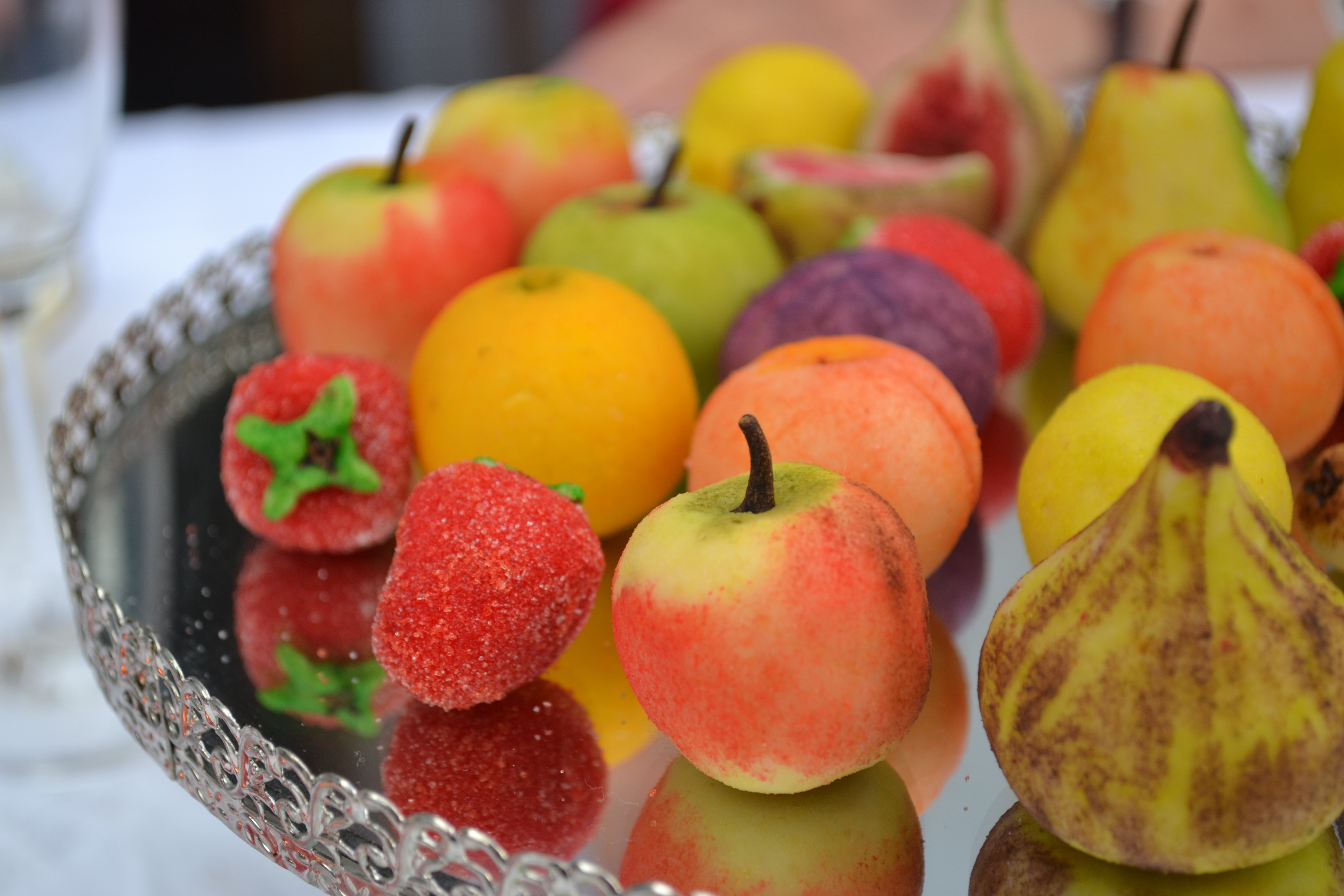
Sicily is the largest island in the Mediterranean Sea belonging to Italy. Sicily has been known for its healthy diet, because of using fresh vegetables and fruits and of course for some sweets including traditional Sicilian fruit-shaped marzipan.
According to legend, a wealthy Italian woman commissioned a convent to be billed in Sicily. The nuns, who later lived there were so grateful and wanted to make something special for community. Using their creativity, they mixed chopped almonds with dough and shaped small pieces of dough into animals and fruits. They got even more creative with painting the animals and fruits with vibrant colors from natural dyes. The sweet treats became so popular especially with kids that they kept the nuns pretty busy.
Toledo is a charming town at the heart of Spain. Once, known for its tolerance, where three cultures coexisted together: Christian, Jewish and Muslim. Today the city is famous for two gastronomical products: Manchego cheese and marzipan.
According to legend, after a battle, there was famine. There was no wheat to make bread. However, there was plenty of sugar and almonds. The nuns from the nearest convent outside Toledo walls mixed the almonds with sugar and fed hungry people. The sweet delicacy was quite different from regular bread, but it worked for the survival time. Much later, it became famous as a sweet treat.


Friday, April 24, 2015

The Story of Maps

The earliest positive evidence of map making stems from Babylonia (left), where a cadastral (real estate) survey for the purpose of taxing property was functioning in the age of Sargan of Akkad (2300 BC).

Cartography slowly evolved over centuries, but the first and most important stage of its development took place in Alexandria, the Roman capital of Egypt during the hundred years before the pre-Christian era. Situated only twelve miles from the mouth of Nile, the city was the epicenter of information, the place where goods from India and Arabia were exchanged.
Twenty-five years before the birth of Christ and 300 years since its founding Alexandria was a cosmopolitan city, a melting pot of humanity from the far corners of the earth. It was a place from travelers and a haven for scholars.
Strabo of Amasia (64/63 BC – AD 24), Greek geographer, well-traveled for his time, came to Alexandria for a visit and stayed for five years. It is doubtful whether he ever compiled a map. Yet nearly all that is known about Greek cartography prior to the work of Claudius Ptolemy (1500 AD) can be traced back to the writings of Strabo of Amasia and no further.
The earliest maps were based on personal experience and familiarity with a local situation. They showed the path through the forest to the neighboring tribe, places where game, water and salt could be found, the distance and direction, which became increasingly important as civilization expanded.
Dicaearchus of Messana (350-285 BC), Greek geographer, made a start by drawing a straight east-west line across the map of the habitable world as he knew it, introducing the first geographical coordinates.
The sun gave to cartography its first three standard lines of partition: the equator, the Tropic of Cancer and the Tropic of Capricorn.
The basic facts concerning the sun’s behavior came from the common man, the shepherd and the farmer, the fisherman and the camel driver of primitive civilization. They recognized the sun as the giver and supporter of life, and were vitally interested in its habits.
Eratosthenes (276-195/194 BC), Greek geographer, introduced a north-south line, incorporating parallels and meridians. He is best known for being the first person to calculate the circumference of the Earth. He was also the first to calculate the tilt of the Earth’s axis.
Hipparchus’ (190-120 BC), Greek geographer, greatest contribution to cartography was laying the foundation of trigonometry.
Claudius Ptolemy’ (AD 90-168), Greco-Egyptian geographer, Atlas of the World was an unsurpassed masterpiece for almost 1500 years.
Medieval cartography from AD 300 to 900 was predominantly Christian in origin. The geographical statistics complied during the Dark Ages were spotty and in general unreliable. Nothing new was added except confusion and theology.
Trips of Marco Polo (1254-1324), the greatest traveler and explorer of the Middle Ages, with his brothers proved that there was another world in Asia. He unrolled the map of Asia to its eastern limits and traced a route across it, “naming and describing kingdom after kingdom which he had seen. He was the first to speak of the new and brilliant court which had been established at Peking; the first to reveal China in all its wealth and vastness, and to tell of the nations on its borders; the first to tell more of Tibet than its name, of Sumatra and of other islands of the archipelago, of the Nicobar and Andaman Islands, of Ceylon and its sacred peak, of India…”
Portugal became the greatest maritime and colonizing power in Europe during the period of discoveries (1415-1499). Henry of Portugal, surnamed the ‘Navigator’ (1394-1460) also bearing the title of ‘protector of Portuguese studies.’ His most important contribution to map making was his revival of scientific method: training his men to apply mathematics and astronomy to their navigation and the charting of strange waters.  His persistence and inspiring leadership brought fame to the Portuguese marine and fortune to the crown.
Christopher Columbus (1450-1451), the dreamer and navigator, pinned his hopes on Ptolemy and discovered a new world – by accident.
The new discoveries brought development of charts. One of the most prolific chart makers of the sixteenth century was Battista Agnese (1500-1564), who flourished between 1536 and 1564. There were no originality in Agnese’s cartographical work, but there are important historical compilations, showing many new discoveries. 
With Gutenberg’s invention Ptolemy’s Geographica or the Atlas of the World was multiplied by the printing process.
Gerardus Mercator (1512-1594) was the first to use the term ‘atlas’ for a collection of maps.
Willem Blaeu (1571-1638) was a Dutch cartographer, atlas maker and publisher. His best publication was the great Atlas Major in twelve volumes, in many respects the most beautiful geographical work ever published (left).
About 1700, a little book was published in England by John Smith entitled The Art of Painting in Oyl, to which is added the whole art and mystery of colouring maps.
Between 1650-1700 there were 18 map making centers in Europe.
Scientific cartography was born in France during the reign of Louis XIV (1638-1715), the offspring of astronomy and mathematics. The principles and methods were unchanged for over two thousand years, but there was something new – a telescope and a timekeeper. The result was a revolution in map making and a start towards an accurate picture of the earth.
The first map of France was drawn by Oronce Fine (1494-1555) and printed in woodcuts in 1525. The first general maps of the territory using a measuring apparatus were made by the Cassini family during the 18th century.
Joseph-Nicolas Delisle (1688-1768) after nearly twenty-two years in Russia returned to France with hundreds of maps and charts. It was a priceless collections of the most inaccessible regions about which Europeans knew almost nothing.
Until the end of the 19th century, world cartography was in many respects similar to French cartography in the days of Louis XIV. Surveys and maps of foreign parts were too costly.
Therefore, the first International Geographical Congress was held in Antwerp in 1871, where many questions were raised and discussed, but none was solved. Nevertheless, subsequent meetings followed and led to the establishment of the permanent organization in Brussels in 1922. At those meetings nations had been invited to exhibit maps and charts, both historical and up-to-date, and several nations responded.
“As for the world at large, it is impossible to know a country well, to understand its social, economic and political problems, without adequate maps of the area. We cannot hope to negotiate a world peace without a thorough knowledge of every part of the world, without world maps, complete and on as many scales as are necessary to give us a thorough understanding of what we are talking about. Maps are synonymous with strategy…which wins peace if not prosperity. But until such time as man can, without restriction or fear, sail up to his neighbor’s shore, travel across his dominion, the map of the world must wait and cartography go impeded.”

Source: The Story of Maps by Lloyd A. Brown

Saturday, April 11, 2015

Legendary Sweet Delights of European Cities

Many European cities are known for their sweet creations. Many of them have their legends how those sweets came to be. Next time you have a marzipan or pretzel, you will know the story behind its origin.

Image result for tallinn's marzipan  At the oldest pharmacy in Europe, Tallinn Town Hall Pharmacy, worked a bright apprentice named Mart. One day, one of the members of the city council got sick. He came to the pharmacist to make him a miraculous remedy. But the pharmacist himself got cold and asked Mart to prepare the remedy. Mart being not only a smart apprentice, but also with a bit of mischief up his sleeves, added almonds received from merchants traveling to the far lands, “Just to make it a bit sweeter and tastier.” Tastier it was, the council was so happy with the remedy that he ordered more on regular basis. The remedy was further modified into a paste of grinded almonds and sugar and in honor of its creator was called Mart’s Bread. Today known as marzipan.

More about the marzipan history at http://martsipan.ee/en/martsipani-ajalugu

Image result for turin's chocolateTurin, located in the Piedmont region of Italy, is known for its hazelnut chocolate, which was created by necessity during Napoleon’s regency, when the import was under a blockade by the British. Due to the shortage of cocoa, it was mixed with hazelnuts from the Piedmont region. As a result manufacturer Caffarel invented Gianduia in 1852.

Image result for eclairParis, France, was home to Antonin Careme, who was abandoned by his parents as a young boy during the French Revolution at the age of 10 or 11. His passion for cooking and precision led him to cooking for high society of Paris and royalty including George IV in London and Tsar Alexander in St. Petersburg. Therefore, he is considered as the first international celebrity chef. He is credited with creating new sauces, dishes, and the standard chef’s hat. Some food historians also credit him with creating éclair.

Torun was once a major trade center in Poland thanks to its location by the river. Many ships passed through its port, bringing spices from different corners of the world. As Torunians developed a good taste for food, they also developed the best gingerbread, which is surrounded by many legends. Here is one of them.

There were many respected bakers in Torun. They baked gingerbread according to their original recipes, which they kept secret; adding some spices and aromas, creating unique signature. By tasting gingerbread, you could tell from which bakery it was. One of those bakers had a beautiful daughter, Katharina. There were many boys, who made advances towards her. One of them was Bartek, a young apprentice.

Katharina liked spending more and more time in the bakery, listening to Bartek’s humming as he was sifting flour through a strainer or mixing dough in a big bowl. During the night, he baked gingerbread in the shape of hearts to hand them to Katharina in the morning. Bartek in his spare time liked going to the nearest meadow, where he could feel the sun on his face, listen to the bird’s chirping and pick up some flowers for Katharina.

One day while sitting by a small lake, he heard a weak voice, “Please, help me.” He looked around and didn’t see anybody. He looked again and noticed a drowning bee. He reached for a leaf from the tree just above him and rescued the poor creature. “Thank you,” said the bee with fluttering wings shaking off the water.

He was about to return to the city when a queen bee sat on his shoulder. “You helped my bee sister and I’d like to return the good deed,” she said. “I’ll tell you a secret of how to make a sweet gingerbread. When making dough, add some honey to it.” And she was gone in a blink of an eye.

And that’s what he did once he got back to the bakery. The sweet gingerbread won him the heart of Katharina and the clients of Torun.


In the Netherlands, in the 13th century, there was a family named Gouda. They settled by the river and built a fortified castle. As the Gouda family was the first one to settle in the area, the town was named after them.

Over the time, Gouda has become famous for trading cheese. Therefore, the cheese was named after the city.  The city is also known for something sweeter, which is made in the city and is well-known. It is stroopwafel or syrup waffle. It was created by a baker using leftovers from the bakery, such as breadcrumbs, which were sweetened with syrup.

The town of Jijona in Spain might be a small town, but it is famous for a sweet turron, which is a type of soft nougat. The oldest Spanish turron recipe dates to the 16th century.

Legend has it that, when the Spanish lands were ruled by the Moors from North Africa, they brought almond trees from their native lands. The King of those times married a Scandinavian princess. The princess was sad that she could not enjoy the scenery full of snow as in her country. King desperate to see her wife happy had an idea to plant thousands of almond trees around the castle. So that when they flourished the landscape would be covered in white hues of petals reminding the princess of snow. The princess was happy for as long as the landscape was covered in white. One of the cooks learned to collect and treat almond produce, creating the first samples of nougat. The white nougat reminding the princess of snow made her happy throughout a year.

Image result for viennese croissantsVienna, Austria, is the creator of the original croissant more in a form of roll in a shape of moon. Legend has it, when Vienna won the siege over Ottoman Empire, one of the bakers noticed a moon on the retreating rival’s flag. And to commemorate their victory, the baker created a croissant in a shape of moon. When Marie Antoinette was betrothed to the King of France, Louis XVI, she introduced croissant to France. In France the roll was turned into a puff pastry, a soft croissant. (As Turks fled, they left bags of coffee behind them. The first coffee shop was born in Vienna).

The story of pretzel is more involved. It is a creation of a few countries and few travelers. It all started in the Alps between two countries of France and Italy. In those mountains stood a monastery. One of the monks living there liked children. He loved telling them stories from the Bible. The kids liked the monk very much and called him father, but they were not so eager to learn the Bible. So he created a pretzel in a shape of two arms crossed resting on shoulders as a reward for learning the Bible. The pretzels became so popular with children that they were introduced to travelers passing by the monastery, where they took rest and were always supplied with food by the monks.

The travelers introduced the pretzel to the bakers of the Bavarian Alps, southern Germany. One of the bakers needed to hire help before lent. The young boy who was supposed to watch the pretzel in the oven snoozed in the warmth of the kitchen. When he woke up and took out the pretzels they turned out to be hard. The baker tried the overbaked pretzel and to his surprised it was still tasty. And after a few days he noticed that the overbaked pretzels lasted longer. They were much better for the travelers passing through the Alps.

So the travelers further introduced the pretzel to the bakers in Hamburg, northern Germany. Over the time, one of the bakers specialized in baking just pretzels. He dusted the pretzels with salt or seeds of sesame, poppy and caraway. The pretzels were taking on different taste as well as shape. Some stayed in its original shape, the others got very tiny; some were straight sticks looking like fingers. His bakery was next to a confection store. He took the idea from the next door confectioner and covered the tiny pretzels in chocolate; some sprinkled with colorful sprinkles some with crushed nuts.

Istanbul, Turkey, is known for lokum or Turkish Delight. This sweet was developed by a confectioner Bekir Efendi, who moved to Istanbul.

Legend has it that in Istanbul a ruler called Sultan was known for a very sweet tooth and for having already the best collection of sweets. Rumor had it that he was looking for a new delicacy to add to his collection. Shortly before this a new baker, who was from a small town up in the mountains moved to Istanbul. Coming from a small town to a big city was a new experience. He didn’t feel welcome and on that note he thought to himself, “How can I welcome the people instead?” He pondered, “What better way to welcome somebody than with a sweet confection.” So he thought of inventing a new treat. The mixture of gel and sugar turned out pretty soft and yummy.” The new confection gained him friends, customers and became the favorite of the Sultan.

Wednesday, April 8, 2015

Easter Egg Traditions of Eastern Europe

Image result for painted houses of bucovina romania  In Bucovina, a northern region of Romania, the Easter tradition of dyeing eggs has been elevated into an art form.


An art inherited from the ancestors. It has been passed on by their grandmothers. The art has persisted for a hundred years. It’s an old craft. It’s inspired by their traditional costumes, which are old and by their houses in Ciocanesti. Ciocanesti has been declared a museum village given the national motifs found on the houses. And that’s where the art has come from. There are fourteen older egg painters in Ciocanesti. The younger generation, who wants to learn the craft carries on the traditions.

Method: Pure beeswax, eggs of chicken, goose, duck, even ostrich. The first step is to empty the egg of its contents, and then washing and drying it. The first stage is white, the second is yellow, and the third one is red. On white, they draw the part of the design that they want to keep white. After that they move on to yellow (dyeing egg in yellow color). Again they paint with wax, on yellow, the parts that they want to stay yellow. After yellow, they move on to the red color (dyeing egg in red color). Again they paint with wax, on red, the parts that they want to remain red. Black is the egg’s background color. After the egg is dyed in black, then it is dried and at a heat source they wipe off all the wax that they have layered on the egg. Then with white clean cloth is cleaned.


You can learn the craft of Orthodox Easter by visiting the region of Bucovina on a 5 day trip April 12 - April 16, 2015.


The Sorbs are Slav descendants who have lived in today’s eastern Germany and western Poland since the 7th century. The decoration of Easter eggs goes back to centuries-old customs and can today be seen as artistic handicrafts.
Method at the Source: http://www.grundschule-pretzschendorf.de/en/Projects/eastereggs.html


Polish Method: Make simple motifs (for example use one of the motifs from the eggs below right) on unboiled eggs with beeswax. (Some suggest letting it cool for 2hrs). Boil water with onion peels, add vinegar. Once brownish color is visible, add eggs and boil for a few minutes. Let it cool. If any wax left, then remove it. You can rub eggs with butter to make it shiny.

Simple motif demonstration at https://www.youtube.com/watch?v=vHA5RrOwzgc


Serbian creativity includes collecting little leaves and sticking it to eggs, wrapping it with a stocking, and dyeing in onion skin giving it brownish color. Once boiled the wrap is removed leaving natural design of leaves.
Source: https://arhitekturaplus.wordpress.com/2012/04/13/serbian-easter-easter-eggs/